Maybe you have been thinking about working in home care, but the words 75-hour Home Health Aide training leave you with a very reasonable question: What will I actually do during those hours? Will I sit through lectures, take tests, practice caring for a person, or all three?
The short answer is that learning to assist someone at home involves more than remembering definitions. You need to understand what safe care looks like, know when something is outside your responsibilities, communicate with respect, and demonstrate important skills. A good starting point is to know what the course covers and how to prepare for its hands-on portion before you enroll.
This guide walks through the current FTC Online Academy 75-Hour Home Health Aide Training Program, the types of lessons in its catalog, and realistic ways to organize your study time. It is a guide for prospective students, not a substitute for the course syllabus, instructor directions, or an employer's requirements.
Start with the job, not the course title
Home health aides help people with everyday needs in their own homes. Depending on the care plan and the employer's rules, support may involve personal hygiene, dressing, safe movement, meals, observing changes, and communicating concerns to a supervisor. The setting is personal: you may be stepping into someone's living room, bedroom, or kitchen rather than a classroom or hospital.
That changes how you think about care. Before touching someone's belongings or helping with a task, you need to ask permission, protect their privacy, and respect their choices. If a client wants to try a safe task independently, your instinct should not automatically be to take over. Helping well means supporting independence when it is appropriate, while recognizing when assistance or escalation is needed.
That combination of practical knowledge and respectful communication is why HHA training includes several different topics instead of only a skills checklist.
What is included in FTC's current 75-hour HHA course?
The FTC course catalog currently lists the program for $610. Its description identifies structured online lessons, instructor narration, 22 clinical skills demonstrations, realistic home-care scenarios, and knowledge assessments. It also explicitly states that students must attend in-person clinical skills training and competency evaluations at FTC Training Center in North Lauderdale, Florida, after completing the online work.
That last point matters. This is not a fully online training program. Watching a transfer demonstration on a screen can help you understand the sequence, but it is not the same as demonstrating the skill while an instructor observes you. The published course description says an FTC certificate of completion is issued only after the required learning activities are finished and the RN instructor verifies and signs off on the clinical skills evaluation.
Course pricing, availability, access periods, and schedules can change. Check the current HHA program page before paying, especially if you need to coordinate travel, childcare, or time away from work.
The first part: understanding your role and the people you will assist
FTC's current online lesson outline starts with orientation and the aide's role in home health care. It then moves into the foundations of safe client care, understanding clients, and everyday care. These are not just introductory topics. They answer questions you may face throughout the day: Who gives the instructions? What should be documented? When should you contact a nurse or supervisor? What happens when a client says no?
For example, imagine a client tells you that they feel dizzy when they stand. Your responsibility is not to diagnose the cause. You need to recognize the concern, avoid rushing an unsafe movement, follow the care plan and your training, and report the change through the proper channel. Learning the boundaries of the aide's role helps protect both the person receiving care and the aide.
Another essential topic is communication. A client may speak softly, take extra time to answer, have hearing difficulty, or prefer a language different from yours. Listening carefully, using simple language, and asking before helping can make the experience more comfortable. Respect is a practical care skill, not an optional personality trait.
The next part: safety, personal care, and everyday routines
The FTC lesson outline also covers special care needs, home management and nutrition, caring for yourself, HIV and AIDS awareness, CPR and emergency care, and real-life home-care scenarios. Students should expect to connect classroom ideas to ordinary moments in a client's day.
Infection prevention is part of almost every task
Hand hygiene matters before and after appropriate care activities. So does paying attention to supplies, clean and dirty items, and the order in which tasks are performed. It is easy to focus on the big skill and overlook a smaller safety step. In training, the smaller steps count because they help reduce risk in real settings.
Personal care requires privacy and dignity
Helping someone bathe, dress, or use the bathroom calls for discretion. Explain what you are about to do, close doors or curtains when needed, and keep the person covered as much as possible. A person should not feel as though their dignity disappears because they need assistance. Practice the words you will use, not only the hand movements.
Nutrition and observation belong together
Mealtime support may look simple, but an aide needs to notice the care plan, the person's positioning, their ability to participate, and changes that require reporting. Home management is not a reason to invent new clinical tasks. Learn what is assigned, what is safe, and what should be referred to the appropriate professional.
Why FTC includes 22 clinical skills demonstrations
FTC's learning catalog currently lists 22 clinical skills, each paired with a reading or study activity, a video demonstration, and a seven-question knowledge check. That arrangement gives students several ways to approach a task: understand its purpose, watch the sequence, and check what they remember. The topics include handwashing, walking with a gait belt, helping with a bedpan, changing occupied bed linens, supported side-lying positioning, feeding assistance, measuring pulse and respirations, mouth care, and bed-to-wheelchair transfers.
You do not need to memorize all 22 skills on your first day. A more productive approach is to group them by purpose. Handwashing and indirect care are about safety and respectful preparation. Positioning, walking, and transfers involve movement. Oral care, dressing, and bathing involve personal care. Pulse, respirations, and output measurements involve careful observation and recording. Grouping helps you see patterns instead of treating every demonstration as an unrelated task.
For each video, ask yourself four questions: What should I check before beginning? What steps protect the client? What information must be observed or recorded? What should I do if something is not safe or does not go as expected? Write down questions for the instructor rather than guessing when you are unsure.
A workable study routine for busy adults
Many people entering healthcare training are balancing classes with work, family, and other responsibilities. You may not have a quiet afternoon available every day. You can still study effectively by creating a routine that fits your life. The sample below is a personal study framework, not FTC's official class timetable, and it does not replace required training hours or attendance.
Before a study session: choose one outcome
Pick a manageable goal, such as explaining handwashing steps, understanding a client's right to refuse care, or identifying what to report after measuring respirations. Open the lesson, keep a notebook nearby, and put distractions aside. A clear goal is better than promising yourself you will somehow study everything.
During the session: learn, say it back, and practice recall
Whenever possible, read the assigned material before watching the demonstration. Pause the video at a natural break and explain the next step in your own words. After the video, close your notes and write down the important safety points you remember. Then complete the knowledge check and review mistakes carefully. If you miss a question, go back to the exact concept instead of simply retaking it until the answer looks familiar.
After the session: build a short question list
Keep one page for questions that need instructor clarification. You might wonder how a technique changes when a client has limited movement or how to document an observation without making a medical judgment. Some questions are better answered during supervised instruction, where the instructor can demonstrate the appropriate method and explain its limits.
Before in-person skills: prepare the logistics
Confirm the date, location, arrival instructions, required clothing or supplies, and any paperwork. Check how you will travel to FTC Training Center. If the skills session follows online lessons, leave yourself time to review the demonstrations beforehand. Arriving prepared lets you focus on feedback instead of scrambling for missing information.
What happens during in-person skills training?
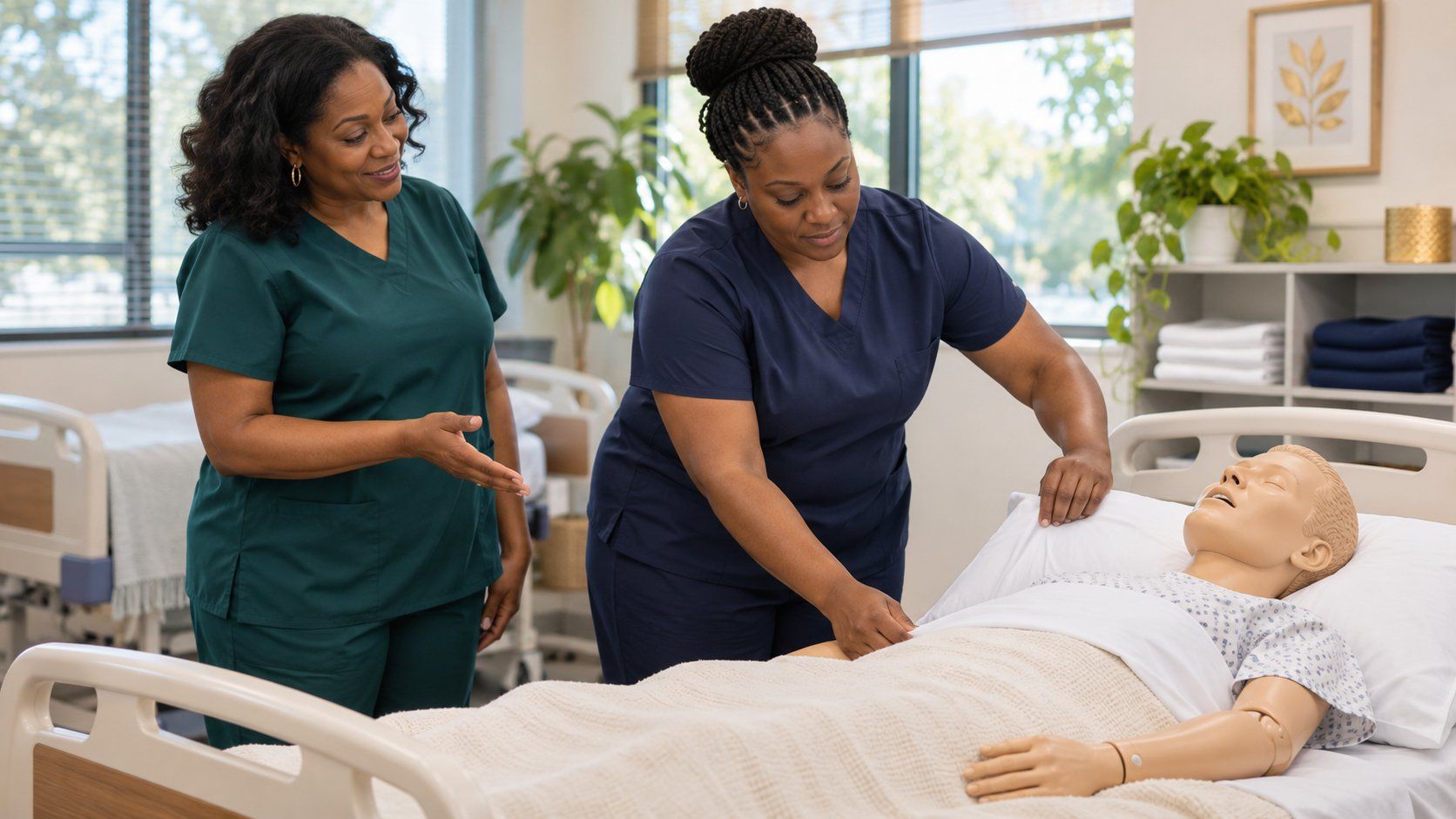
In person, the emphasis shifts from understanding the steps to demonstrating them. An instructor can see whether you set up a safe environment, communicate with the client, follow the sequence, observe precautions, and respond appropriately to directions. This is also when you can ask questions about positioning, body mechanics, and any steps that were difficult to visualize online.
Practice is not about rushing through a task. Imagine transferring a client from a bed to a wheelchair. The details of the care plan, equipment, safe positioning, and instructor guidance matter. Trying to finish quickly is not a substitute for checking the environment and moving carefully. In the supervised setting, focus on doing each step correctly and explaining what you are doing.
FTC's current course description requires RN instructor verification and sign-off for its final clinical skills evaluation. Completing the online learning alone does not meet the program's stated certificate-release condition. Ask the school to confirm how any required make-up work, additional practice, or reassessment would be handled for your class.
How HHA training relates to Florida requirements
Florida has different requirements depending on the type of home health agency. The Florida Agency for Health Care Administration (AHCA) explains that state-licensed-only agencies and Medicare- or Medicaid-certified home health agencies follow different training or competency pathways. For state-licensed-only agencies, AHCA describes at least 40 hours of training or the specified competency test. For agencies subject to the federal home-health requirements, one qualification route combines at least 75 hours of classroom and supervised practical training with a competency evaluation; other qualifying routes are described in 42 CFR 484.80.
AHCA also says that home health aides are not individually licensed or certified by AHCA or another Florida state agency. For that reason, do not confuse a school's training certificate with a state-issued HHA license. The specific agency where you hope to work may request training records, competency documentation, background screening, CPR, or other items. Confirm those details with the employer and current official rules before assuming that a course automatically qualifies you for a particular position.
Students who are considering additional work as nursing assistants should also understand that FTC's CNA training and exam-preparation program is a separate offering. Completing an HHA program does not, by itself, mean you have passed Florida's CNA certification examination.
Five questions worth asking before you enroll
1. What parts of the program will I complete online, and which skills must I demonstrate in person? Ask for the current learning sequence and hands-on attendance requirements, not just the total number of hours.
2. When are the in-person sessions, and what if I have a schedule conflict? Confirm the dates and any available make-up policy before arranging work shifts or transportation.
3. What do I need for course access? Check your internet connection, device, student login, and any access deadline shown in the enrollment details. If you prefer studying on your phone, test whether you can view lessons comfortably.
4. How is completion determined? Ask about lessons, knowledge checks, required demonstrations, final evaluations, and how the instructor verifies your clinical skills.
5. What does a prospective employer require? Review the agency's hiring requirements directly. A school can explain its training, but an employer determines its hiring standards within applicable law.
Frequently asked questions
Can I complete FTC's HHA program entirely from home?
No. The current course description includes online study, followed by required in-person clinical skills training and competency evaluation at FTC Training Center in North Lauderdale, Florida. Plan for both parts before registering.
Does the $610 course include a state HHA license?
The current FTC catalog lists the HHA program at $610, but AHCA says Florida does not issue an individual state HHA license or certification. FTC's completion documentation is a training record, not a state HHA license. Check the current enrollment page for what the tuition includes.
Do I have to be good at computers?
You need a practical way to open the online learning activities and complete knowledge checks. If technology feels unfamiliar, learn how to sign in, navigate lessons, and resume your work before you begin a long study session. Contact the school through its website if you need enrollment or access guidance.
Will finishing the course guarantee a job?
No course can promise a job offer. Training can help you build knowledge and demonstrate skills, while employment depends on the employer's requirements, the available positions, and your own application process. FTC's catalog also includes a career-success lesson on résumés, interviews, and jobs to support preparation.
Can I take HHA continuing education instead of initial HHA training?
They serve different purposes. An initial training program is for building foundational knowledge and skills. Individual in-service topics or an HHA in-service package are intended for continuing learning; they should not be assumed to replace an employer's initial training or competency requirements. Verify the individual topics and hours before choosing a package.
Your next step: choose a course that fits your responsibilities
If home care interests you, start by reading the full FTC 75-Hour HHA Training Program description. Look at the learning requirements, review your calendar for the in-person skills sessions, and keep a short list of questions about enrollment and completion. You can also explore the broader FTC Online Academy course catalog to compare training and continuing education options.
The goal is not to collect a course title as quickly as possible. It is to understand the care you will be learning to provide, make room for genuine practice, and know exactly what you must complete. That is a much stronger way to begin.
 FTC Online AcademyFTC Training Center
Visit FTC Training Center
3601 W Commercial Blvd, Suite 5North Lauderdale, FL 33309 Get Directions & Travel Time
See the distance and estimated travel time from your location in Google Maps. You can also enter a starting address.
For help verifying a course completion certificate, contact FTC Training Center.
Verify Certificate